How Invisalign® Works for Orthodontic Correction
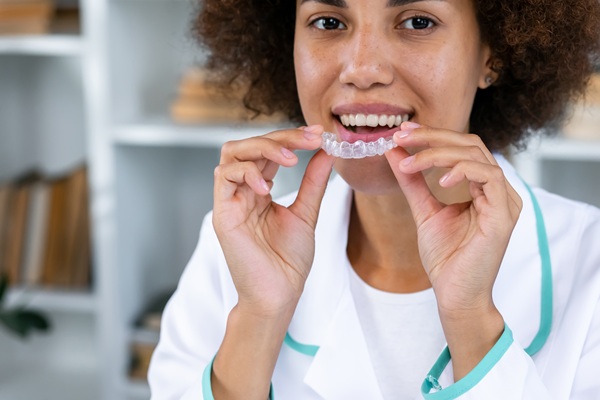
Considering Invisalign®? Read on to learn more about this teeth-straightening option. Many individuals who desire to straighten their teeth and fix their smile's spacing problems can now opt for Invisalign®. Traditional metal braces used to be the only choice for orthodontic treatment, but many people struggled with them due to their appearance. Invisalign uses a set of transparent aligners to straighten teeth and correct the bite.
An overview of Invisalign®
Since its debut in the early 2000s, Invisalign has grown in popularity. Not only does Invisalign utilize transparent aligners that are barely visible on the teeth, but they may also be removed for mealtime and regular brushing and flossing.
Patients are often left wondering how Invisalign works since it utilizes transparent aligners that are removable instead of conventional metal braces. Despite the differences in their techniques, Invisalign can achieve outcomes comparable to metal braces in most instances.
Understanding orthodontic treatment
To comprehend how Invisalign works, it is necessary first to have a fundamental idea of orthodontics. In its most basic form, orthodontic therapy involves applying continuous mild pressure to the teeth to shift them. The bone around the teeth softens due to the pressure, allowing them to shift in the direction of the pressure. The teeth may shift, rotate, and move up or down depending on the position and intensity of the pressure.
All orthodontic techniques follow the same operating principle, but they use various devices to do this. Traditional metal braces, for example, use individual brackets on the teeth and an archwire. Additional orthodontic equipment, like elastics, may be used in certain instances to achieve the desired outcomes.
How Invisalign works
The clear aligner trays are what makes Invisalign works. The clear plastic material is designed to fit tightly around the curves of the teeth, allowing pressure to be delivered where it is needed most.
The aligners will be replaced as the teeth begin to shift into their proper position. This means patients will be changing their aligners every one or two weeks, depending on the dentist's instructions. Each aligner is intended to achieve a particular movement, allowing the alignment of the teeth to improve over time gradually. The dentist will typically provide a few aligners so that a dental appointment will not be necessary every time the patient needs a new tray.
There is, however, one essential component to Invisalign's functions. The aligners must be worn for at least 22 hours each day. Failure to wear the trays as recommended means the treatment may not proceed as intended, and patients may have to wait longer to get the results they want. The easiest method to deal with this is to take the aligners only when eating, brushing, or flossing.
Ready for straighter teeth?
Invisalign aligners are designed to apply gentle pressure to the teeth to shift them over time. Despite the differences in execution, Invisalign uses the same fundamental orthodontic technique as metal braces and produces comparable outcomes.
Request an appointment here: https://jgdentalgroup.com or call JG Dental at (949) 485-5800 for an appointment in our San Juan Capistrano office.
Check out what others are saying about our dental services on Yelp: Invisalign in San Juan Capistrano, CA.
Related Posts
Unlike other body organs, your teeth cannot regenerate when damaged. Therefore, you will need to repair the teeth with synthetic materials to have a full-functioning smile. Here are some tips from a family dentist to help maintain proper oral care to preserve the only set of natural teeth you will ever have.Brushing removes plaque, a…
Children need to develop healthy oral care habits at a young age so they will carry them into their teenage and adult years, and in this review from a family dentist, we discuss several ways that parents can help protect their children's oral health with healthy habits. We also discuss how a family dentist can…
A cosmetic dentist frequently helps patients choose between dental bonding and veneers to achieve a brighter, more symmetrical smile. Both procedures effectively resolve many impurities. However, the ideal selection centers on the current condition of the teeth, the specific aesthetic goals, and the desired longevity of the results.Dental bonding comprises a tooth-colored composite resin that…
Dental anxiety is common among children and adults. Thankfully, a family dentist has tools and techniques to help patients manage their anxiety while completing preventative and restorative dental work. This article will explore dental anxiety, how to manage it, and how to overcome it.Dental anxiety is when a patient feels fearful, stressed, or anxious about…