
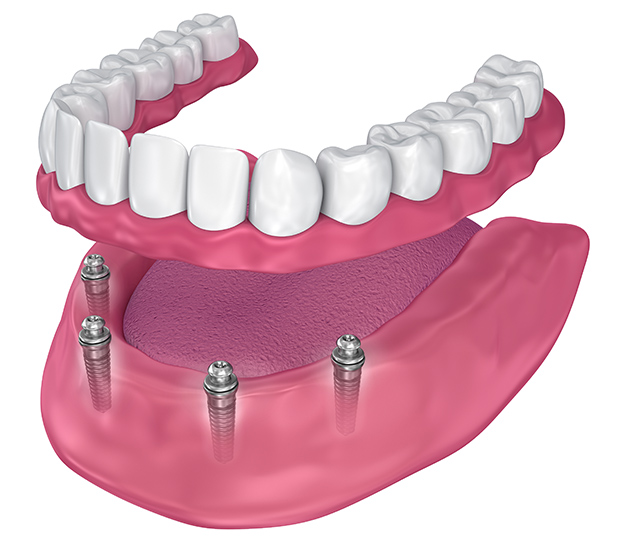
All-on-4 replaces a full jaw of teeth on four implants instead of one implant per tooth. The two back posts go in at an angle, so they catch bone that is still solid, and a fixed bridge is attached the same day.
Why four implants and not one for every tooth?
Because a full arch does not need a post under every tooth to stay put. Four posts, placed where the bone is thickest and angled to spread the load, carry a bridge of ten to twelve teeth.
The angle matters more than the number. Tilting the back implants lets them reach denser bone at the front of the jaw and skip the thin areas above the sinus — which is often the very reason someone was told they had too little bone for implants.
Fewer posts also means fewer surgical sites, one healing period instead of several, and a shorter overall treatment.
Do I really leave with teeth the same day?
Usually yes — a temporary fixed bridge goes on at the end of the surgery. It is not the final one: it is lighter, and it is there so you never walk around without teeth.
The temporary bridge stays for the months while the bone knits around the posts. During that time you eat soft food — the implants are holding, but they are not yet fused.
The final bridge is made after healing, when the gum has settled into its long-term shape. That is the one built to last and matched properly for colour and bite.
How is it different from a denture?
A denture rests on the gum and comes out. An All-on-4 bridge is screwed to the implants and stays in — you clean around it rather than taking it out at night.
That difference shows up most in eating. A denture moves when you bite into something firm, and the palate coverage on an upper denture dulls taste. A fixed bridge does neither.
It also slows the bone loss that follows tooth loss: implants transmit chewing force into the jaw, and bone that is being used holds up better than bone that is not.
Am I a candidate?
Most people who have lost, or are about to lose, a full arch are — including many who were told they had too little bone for conventional implants. It is decided on a scan, not on age.
What we look at: how much bone is left and where, the health of the gums, how the jaws meet, and general health conditions that affect healing. Uncontrolled diabetes and heavy smoking both matter here, and both are worth discussing openly before planning.
If a scan shows the bone will not support four posts, there are other routes — more implants, a graft first, or an implant-supported denture. The consultation is where those get compared for your case.