
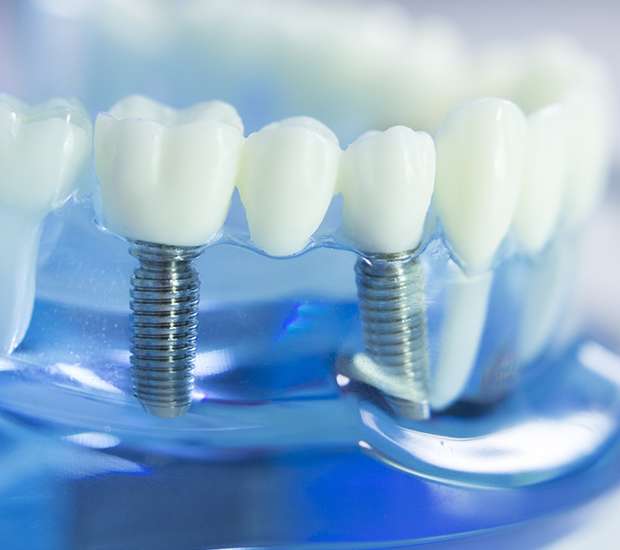
A dental implant is a small titanium post placed into the jawbone, where it takes over the job of a tooth root. A crown, bridge or denture is attached on top. It stays fixed in place, it is cleaned like a natural tooth, and nothing has to come out at night.
How long does the whole thing take?
Most cases run three to six months from the first surgery to the final crown. The waiting is not idle time — the bone has to grow tightly around the post before it can carry a bite.
The visits themselves are short. Placing the post takes about an hour under local anaesthetic, and most people are back at desk work the next day. Between the surgery and the crown you wear a temporary tooth, so there is no gap on show.
Cases where the bone is thin need a graft first, and that adds a few months. We only know this after a scan — it cannot be judged from the outside.
Does it hurt?
The surgery itself does not: the area is fully numb. The two or three days after feel like a tooth extraction — swelling and a dull ache, handled with cold packs and over-the-counter painkillers.
Patients who dread the chair usually find the anticipation worse than the day itself. If that is you, say so at the consultation and we will plan the appointment around it.
Call the office if pain grows after the third day instead of fading, or if swelling spreads towards the cheek and eye. That is not the usual course and is worth looking at early.
What if the tooth has been missing for years?
It usually still works, but the jaw may need rebuilding first. Bone that no longer carries a root gradually shrinks, and after several years there may not be enough left to hold a post.
That is what a bone graft is for: material is added, left to knit into your own bone, and the implant goes in afterwards. It is routine, and it is the main reason a timeline stretches.
A scan settles the question in one visit. Until then neither of us can know whether a graft is needed.
How do I look after it?
Brush and floss it like a natural tooth and keep your checkups. The implant itself cannot decay, but the gum around it can become inflamed — that is what puts implants at risk.
A water flosser helps around the post, where a brush reaches poorly. At checkups we look specifically at the gum around the implant and at how the bite sits: an implant does not sense pressure the way a natural tooth does, so an uneven bite can go unnoticed.
Smoking slows healing and raises the chance of failure. If you have been meaning to stop, the weeks around surgery are a good moment.
Questions we get asked
Words used on this page
Choose your JG Dental office
This information is shared by the practice. Services, appointment availability and individual treatment options must be confirmed with the selected office.
San Juan Capistrano — 32382 Del Obispo St Ste C2. (949) 493-6006
Newport Beach — 1501 Superior Ave Ste 302. (949) 548-8218