
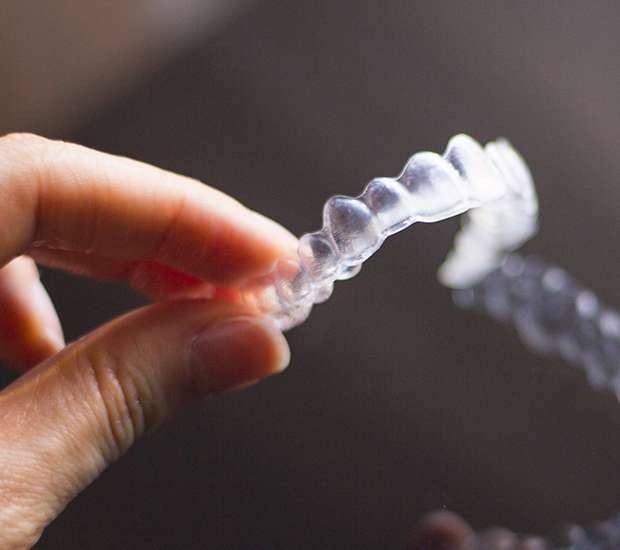
Invisalign moves teeth with a series of clear removable trays instead of fixed brackets and wires. Each tray shifts the teeth slightly, and you change to the next one every one to two weeks.
Will it work for my case, or do I need braces?
Aligners handle crowding, spacing and many bite problems well. Severe rotations, teeth that need moving vertically a long way, and some jaw discrepancies are still better with fixed braces.
The honest answer comes from a scan. We scan both jaws, plan the movement digitally, and you see the projected end position before committing — if the plan cannot get there, that shows up at this stage rather than a year in.
Sometimes the answer is a combination: a short period of fixed braces for the difficult movement, aligners for the rest.
How many hours a day do I actually have to wear them?
Twenty to twenty-two. They come out to eat and to clean your teeth, and go straight back in. This is the part that decides whether treatment finishes on schedule.
The common failure is not wearing them at night or leaving them out through long meals. Teeth drift back quickly, and a tray that no longer fits means going back a step.
Most people settle into it within a week. A speech lisp in the first days is normal and disappears as the tongue adapts.
How long does treatment take?
Simple cases finish in about six months, average ones in twelve to eighteen. The estimate comes with the digital plan, not before it.
Timelines stretch when trays are worn less than planned, and when teeth track slower than predicted — which happens, and is handled with a refinement set of extra trays.
Refinements are normal and usually included. Ask what the arrangement is before starting, so it is not a surprise later.
What happens after the last tray?
Retainers, indefinitely. Teeth have a memory and drift back towards where they were, most quickly in the first months after treatment.
The usual pattern is full-time wear for a while, then nights only. A fixed retainer bonded behind the front teeth is an option when the risk of relapse is high.
Losing retainers and not replacing them is the most common reason people end up in aligners twice.
Questions we get asked
Words used on this page
Before an aligner consultation
Bring dental records and describe your goals, previous orthodontics, retainers and jaw symptoms. Ask whether the teeth and gums are healthy enough to start, whether your bite needs another approach and who monitors progress. Clarify the prescribed wear schedule, attachments or other procedures, cleaning, follow-up and retainers after treatment. Clear aligners are not suitable for every case; do not select them on appearance or an assumed fixed completion time alone.
Choose your JG Dental office
This information is shared by the practice. Services, appointment availability and individual treatment options must be confirmed with the selected office.
San Juan Capistrano — 32382 Del Obispo St Ste C2. (949) 493-6006
Newport Beach — 1501 Superior Ave Ste 302. (949) 548-8218